My step-mother called to say, “You’re banned from the family beach house forever! I’ve changed all the locks!” She laughed. I calmly replied, “Thanks for letting me know.” She had no idea that mom had left me the house in a secret trust before…


The first thing I noticed was the way the last light of the day clung to the glass of my apartment window.
It wasn’t bright anymore, just a soft glow, like the sun was too tired to shine properly. The sky outside was painted in slow-moving shades of orange and pink, and the buildings of Boston stood dark and sharp against it. I stood there for a moment, not moving, letting the quiet settle around me.
It had been a long day. The kind that drains everything out of you without asking. My laptop sat open on the kitchen counter behind me, an unfinished email staring back like it was waiting for an answer I didn’t have. My shoulders felt heavy, my head slightly foggy, and I hadn’t even realized how still everything had become until my phone started ringing.
I picked it up without thinking.
That was my first mistake.
“You’re banned from the family beach house forever.”
Diana’s voice cut through the calm like something sharp. Cold. Precise. Almost pleased.
For a second, I didn’t say anything. I just looked at my reflection in the window. My hair was tied up in a loose, messy bun that had started falling apart hours ago. My sweater slipped off one shoulder. I looked tired. But steady.
“What?” I asked, slowly.
“I’ve changed all the locks,” she continued, her tone stretching each word like she wanted me to feel it. “Do not even think about trying to get inside. This is what you deserve for ruining your sister’s graduation party.”
I blinked once, then let out a small breath.
“You mean the party I wasn’t invited to?” I said.
She gave a loud, dramatic sigh. “Oh please. Don’t start acting like you’re the victim.”
“The same party where you told everyone I was too busy to come?” I asked, keeping my voice calm.
I had learned that a long time ago. Never give her what she wants. She fed on reactions. Anger, frustration, sadness—she took all of it and turned it into something she could use.
Her laugh crackled through the phone. “Everyone knows you’re jealous of Madeline and her success,” she said. “You always have been.”
Jealous.
That word again.
It had followed me for years, ever since she entered our lives. Every time something didn’t go her way, every time she needed to twist a story, there it was. Jealousy.
I looked back out at the skyline, but for a moment, it wasn’t Boston I saw.
It was the beach house.
The wide wooden porch. The pale railing, worn smooth from years of hands resting on it. The sand stretching endlessly beyond, and the ocean moving in slow, steady waves.
And my mother’s voice.
“Look at that wave, Rebecca. I swear it’s bigger than you were when you were five.”
The memory came so clearly it almost felt real. Warm. Soft. Safe.
I blinked and came back to the present.
“The house is not yours to ban me from,” I said quietly.
“Oh, but it is,” Diana replied immediately. “Your father signed it over to me last month. It belongs to me now, and I don’t want you anywhere near it.”
I felt something shift inside me. Not anger. Not even surprise.
Just clarity.
A small smile touched my lips.
“Thank you for telling me about the locks,” I said.
There was a pause on the other end.
“What does that mean?”
But I had already ended the call.
The silence that followed felt different from before. Not heavy. Not draining.
Still.
I lowered the phone slowly and stood there for a moment longer, listening to the distant hum of traffic below. Then I turned and walked down the hallway.
My home office was small, simple, and quiet. The kind of place where everything had its spot. I knelt beside an old metal file cabinet and pulled open the bottom drawer.
The envelope was exactly where I had left it.
Thick. Sealed. Slightly worn at the edges.
My mother’s handwriting stretched across the front.
REBECCA. BEACH HOUSE DOCUMENTS. IMPORTANT.
The word important was underlined three times.
I picked it up carefully and carried it back to my desk. For a moment, I just held it, running my fingers along the edge of the paper. Then I opened it.
Inside, everything was neatly arranged. Documents stacked with care. Official papers. Legal forms.
And the trust.
My chest tightened as I saw her signature at the bottom of the page.
Even now, it looked strong. Certain.
She had known.
Years ago, I had sat beside her hospital bed, holding her hand while machines hummed quietly around us. The room had smelled faintly of antiseptic, but she insisted the window stay open just a little.
“So I can imagine the ocean,” she had said.
“Rebecca,” she whispered, her voice soft but steady. “The beach house is our family’s legacy.”
I remember shaking my head slightly, trying to keep her focused on treatment, on doctors, on anything that might keep her here longer.
But she didn’t let it go.
“My parents built it themselves,” she said. “We raised you there. Every summer. Every memory.”
Her hand tightened around mine, surprising me with its strength.
“Diana has wanted that house from the moment she first saw it,” she continued. “She doesn’t see it the way we do. To her, it’s something to win. Something to own.”
Her lawyer, Evelyn Porter, stood nearby, explaining things in calm, clear terms. I didn’t understand most of it at the time. Words like trust and ownership and protection floated past me, too heavy to hold onto.
But one thing stayed.
The house would always be mine.
My phone buzzed, pulling me back to the present.
A message from Diana.
“I already told the local police you are not allowed on the property. Do not embarrass yourself by trying to break in.”
I stared at the screen for a second, then forwarded the message to Evelyn with a short explanation.
Her reply came quickly.
“It is time to handle this properly.”
Another message appeared, from a different number.
Madeline.
“Mom said you tried to ruin my party. You were never really part of this family anyway.”
I set the phone down.
Madeline had been ten when Diana married my father. Quiet at first. A little unsure. But over time, she changed.
Or maybe she was changed.
Everything became about her. Every achievement I had was somehow turned into something she needed attention for. If I did well in school, suddenly she needed a celebration for something small. If I was praised, the focus shifted to her next event.
After my mother died, it got worse.
Much worse.
The phone rang again.
My father.
I answered.
“Rebecca,” he said, his voice already tired. “Please don’t make this harder than it needs to be.”
No questions. No curiosity. Just that.
“Diana is trying to keep peace in the family,” he continued. “Maybe banning you from the house was too much, but maybe some space would help.”
I looked down at the documents in front of me.
“The beach house belongs to me,” I said calmly. “Mom put it in a trust before she died.”
There was a pause.
I could hear a glass being set down on his end.
“Diana told me you weren’t interested in it anymore,” he said slowly. “She said you didn’t want the responsibility.”
Of course she did.
“I’ll handle this,” I said.
And I ended the call.
An hour later, I booked a flight for the next morning.
The drive along the coast was quiet. A thick fog rolled in from the ocean, wrapping everything in a soft gray haze. When I turned onto the narrow road leading to the house, my grip on the steering wheel tightened slightly.
Through the mist, the shape of it appeared.
Familiar.
And yet… not.
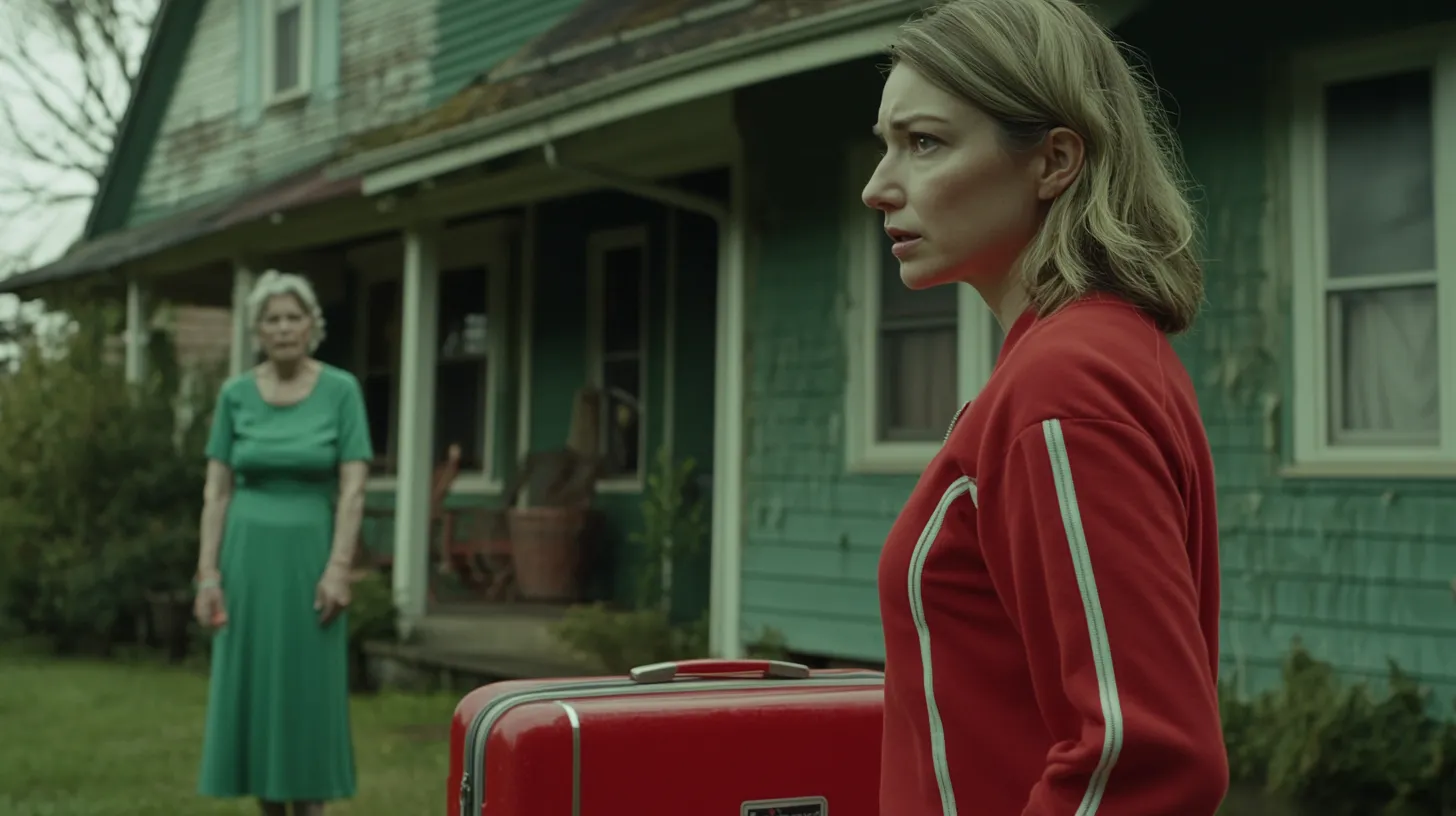
The railing had been replaced. Clean, modern panels instead of the worn wood I remembered. Security cameras lined the corners of the roof. A bright red luxury car sat in the driveway where my mother once kept a small garden shed.
I hadn’t even stepped out of the car when the front door flew open.
Diana marched toward me, her face tight with anger. Madeline followed behind her, holding up her phone, recording everything.
“I told you not to come here!” Diana shouted.
I opened the trunk and pulled out my suitcase.
“Go ahead and call the police,” I said calmly. “I already did.”
Right on time, two patrol cars turned into the driveway.
The officers stepped out, calm and professional.
“Mrs. Crawford,” one of them said. “We received your complaint.”
“Yes,” she snapped, pointing at me. “She has no right to be here.”
The officer opened a folder.
“There seems to be some confusion,” he said. “According to documents provided by attorney Evelyn Porter, this property legally belongs to Miss Rebecca Hale.”
Diana froze.
“That’s impossible,” she said. “My husband signed it over to me.”
“The property was placed in an irrevocable trust,” the officer explained. “Your husband could not transfer ownership.”
Madeline slowly lowered her phone.
I stepped forward and handed over the original documents.
“My mother created the trust,” I said.
At that moment, my father appeared on the porch. He looked confused. Pale.
“You knew about this?” I asked him.
He shook his head slowly.
“No,” he said. “She never explained it.”
Diana turned toward him, furious.
“You let this happen,” she said.
The officer cleared his throat.
“Miss Hale has full legal ownership,” he said firmly. “Any attempt to block her access could result in legal consequences.”
Diana didn’t say anything else.
A few minutes later, her lawyer arrived. He reviewed the documents carefully, flipping through each page.
Then he looked up.
There was nothing he could do.
The trust was solid.
Diana’s face lost all color. Without another word, she turned and walked toward her car. Madeline hesitated for a moment, then followed.
“I didn’t know,” she said quietly as she passed me.
Then she was gone.
The house was silent again.
Only the sound of the ocean remained, steady and endless.
In the weeks that followed, I began to restore everything.
Slowly.
I repainted the porch, bringing back the soft, familiar color it used to have. I found old photographs hidden away in the attic and hung them back where they belonged. I opened windows that had been kept shut and let the ocean air move through the rooms again.
My father started visiting.
At first, it was awkward. Quiet. But over time, something shifted. He began to see things more clearly. The stories he had believed didn’t hold up anymore.
One afternoon, Madeline returned.
She stood in the doorway, holding a bundle of letters.
“I found these,” she said. “They’re from your mom.”
I took them carefully.
“She wrote them before she died,” Madeline continued. “Mom never gave them to you.”
I didn’t know what to say.
I opened the first letter that night.
My mother’s words were calm. Strong. Full of quiet belief.
She wrote about the future. About the life she hoped I would build. About the strength she saw in me, even when I didn’t see it myself.
I read every letter slowly.
Then I read them again.
Months later, on a quiet evening, I found something else.
An envelope, hidden beneath the porch swing.
Inside was one final message.
The house is only a symbol, she wrote. The real legacy is the courage to protect what matters.
I sat there for a long time, listening to the waves.
The sun sank slowly into the ocean, painting the sky in soft colors that felt familiar.
And for the first time, everything made sense.
The house had never just been a place.
It was every memory. Every moment. Every piece of who we were.
And now, finally, it was safe.